The Three Zones
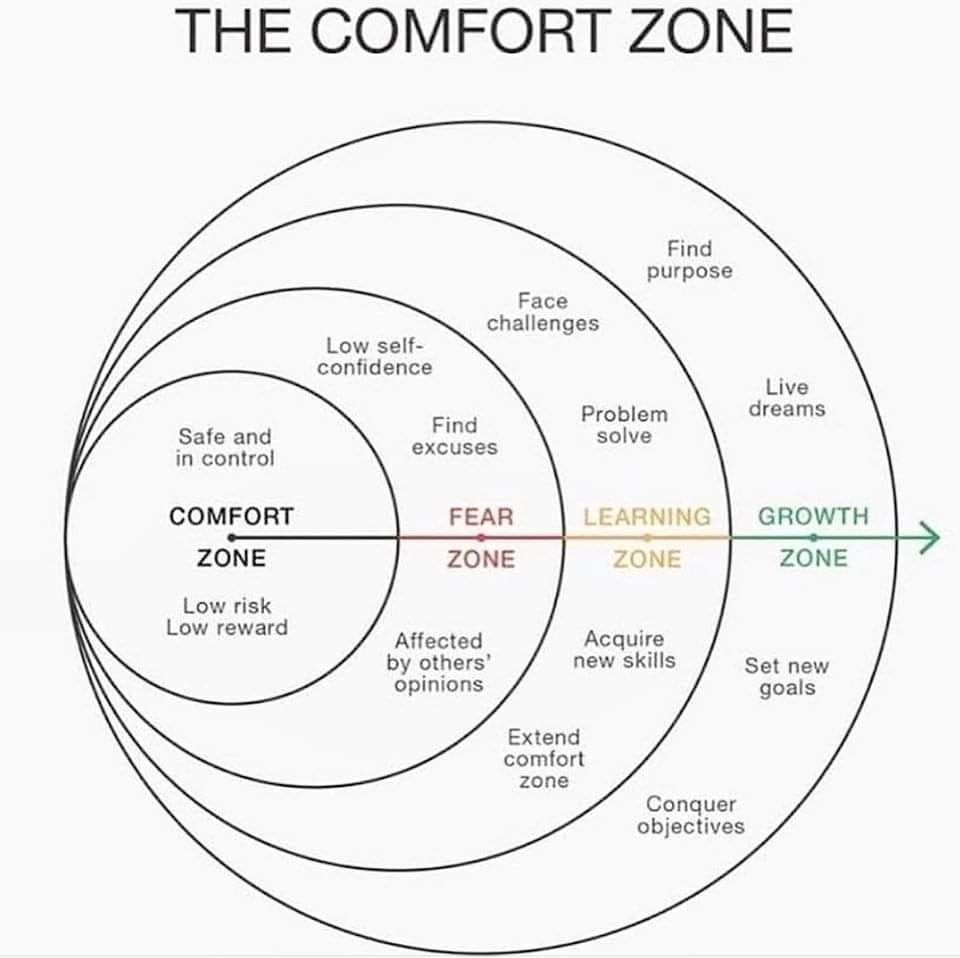
Personal growth of any kind, whether physical, emotional, mental, or spiritual, happens when we leave the familiar behind, but not too far behind. There are three zones to understand:
Comfort zone: Things feel safe, familiar, easy, comfortable. There is no real challenge. Staying here has its place and time, but without any challenge, there is no growth.
Stretch zone: Just at the edge of the comfort zone. Things feel a little uncomfortable, uncertain, or awkward. This is where new neural pathways form, confidence builds, and real growth happens.
Panic zone: Too far outside the comfort zone. The challenge overwhelms rather than builds. You shut down rather than grow. This is not where we want to be (although sometimes life throws us into this area).
An important goal in our group is to spend time in the stretch zone: enough discomfort to grow, not so much that you are overwhelmed or suffering.
The zones are not fixed forever. If you stay in the stretch zone long enough, with repetition and integration, what felt awkward becomes familiar. Your comfort zone effectively expands: it absorbs what used to be stretch. Then, a new stretch zone forms beyond that edge: new challenges, slightly further out. Growth is a gradual widening of the comfort zone.
It Is Different for Everyone
The stretch zone for one person may be the panic zone for another, and what is panic for one person may be comfort for another. The zones are personal, not universal. Therefore, the group calibrates the activities to each individual.
A useful way to think about it: if someone is comfortable at a “level 3 out of 10” in a certain area, the group looks for what a “level 4” might look like for them and gently invites them to try it, if they are ready and willing to do so.
Examples
For someone who prefers quiet and one-on-one interaction:
- Comfort zone: coffee with one close friend
- Stretch zone: attending a small dinner party with six people they partially know
- Panic zone: giving a speech to an audience of a hundred strangers
For someone who fears rejection:
- Comfort zone: texting someone they already know well
- Stretch zone: asking an acquaintance to coffee
- Panic zone: approaching a complete stranger on the street
The Exhilarating Reward of the Stretch Zone
When done with awareness and sensitivity, stretching beyond the comfort zone produces feelings of excitement and aliveness that are simply not available inside the comfort zone. The mild discomfort is the price of admission to something genuinely exhilarating. Over time, there is a quieter reward too: the comfort zone grows, so more of life feels easy and natural than before, not because you avoided challenge, but because you met it.
This is why some activities in the Actualization Club are designed to be inside the comfort zone, while others are designed to gently stretch the participants, always calibrated to an appropriate level.